
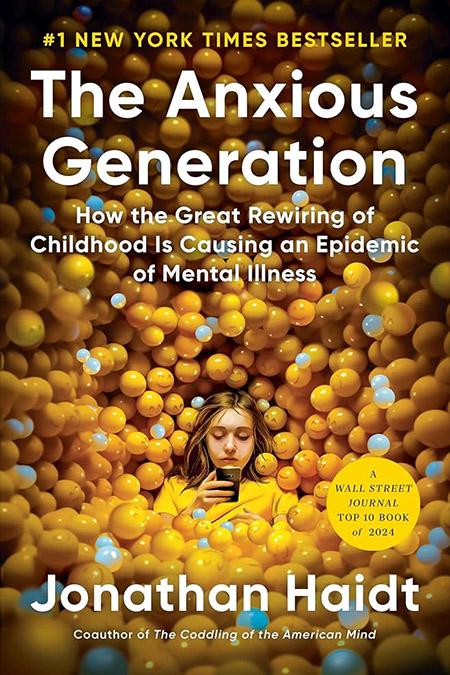
must-read for all parents: the generation-defining investigation into the collapse of youth mental health in the era of smartphones, social media, and big tech—and a plan for a healthier, freer childhood.
“With tenacity and candor, Haidt lays out the consequences that have come with allowing kids to drift further into the virtual world . . . While also offering suggestions and solutions that could help protect a new generation of kids.” —Shannon Carlin, TIME, 100 Must-Read Books of 2024
After more than a decade of stability or improvement, the mental health of adolescents plunged in the early 2010s. Rates of depression, anxiety, self-harm, and suicide rose sharply, more than doubling on many measures. Why?
In The Anxious Generation, social psychologist Jonathan Haidt (pronounced "height") lays out the facts about the epidemic of teen mental illness that hit many countries at the same time. He then investigates the nature of childhood, including why children need play and independent exploration to mature into competent, thriving adults. Haidt shows how the “play-based childhood” began to decline in the 1980s, and how it was finally wiped out by the arrival of the “phone-based childhood” in the early 2010s. He presents more than a dozen mechanisms by which this “great rewiring of childhood” has interfered with children’s social and neurological development, covering everything from sleep deprivation to attention fragmentation, addiction, loneliness, social contagion, social comparison, and perfectionism. He explains why social media damages girls more than boys and why boys have been withdrawing from the real world into the virtual world, with disastrous consequences for themselves, their families, and their societies.
Most important, Haidt issues a clear call to action. He diagnoses the “collective action problems” that trap us, and then proposes four simple rules that might set us free. He describes steps that parents, teachers, schools, tech companies, and governments can take to end the epidemic of mental illness and restore a more humane childhood.
Haidt has spent his career speaking truth backed by data in the most difficult landscapes—communities polarized by politics and religion, campuses battling culture wars, and now the public health emergency faced by Gen Z. We cannot afford to ignore his findings about protecting our children—and ourselves—from the psychological damage of a phone-based life.
THE INSTANT #1 NEW YORK TIMES BESTSELLER • Wall Street Journal Top 10 Book of 2024 • A New York Times and Washington Post Notable Book • One of Barack Obama's Favorite Books of 2024 • A TIME 100 Must-Read Book of 2024 • Named a Best Book of 2024 by the Economist, the New York Post, and Town & Country • The Goodreads Choice Award Nonfiction Book of the Year • Finalist for the PEN Literary Awards
Buy the book on Fishpond.

The aim of this study was to identify problematic gaming behavior among Finnish adolescents and young adults, and evaluate its connection to a variety of psychological, social, and physical health symptoms. This research emphasized that problematic gaming behavior had a strong negative correlation to a variety of subjective health outcomes.
Read More
/afk - Away from Keyboard explores the relationship between online gamers and the games that they play. It examines the evolution of the World of Warcraft from its infancy to its non-existent conclusion and beyond. Through the lives of several key characters, this film shows the real joys associated with online games while offering an objective look at some of its inherent trappings.
Read More
Peter Attia interviews Anna Lembke who is the Chief of the Stanford Addiction Medicine Dual Diagnosis Clinic and author of Dopamine Nation: Finding Balance in the Age of Indulgence. In this episode, Anna dives deep into the biochemistry and neurobiology of addiction, exploring the critical role of dopamine and the prefrontal cortex. She shares her framework for diagnosing and treating addiction, providing real-world examples involving alcohol, gambling, cannabis, social media, and more.
Read MoreScreen Sense offers personalised one-to-one support to help you better understand your digital habits and make practical, lasting changes to the way you use technology.
Sessions >


