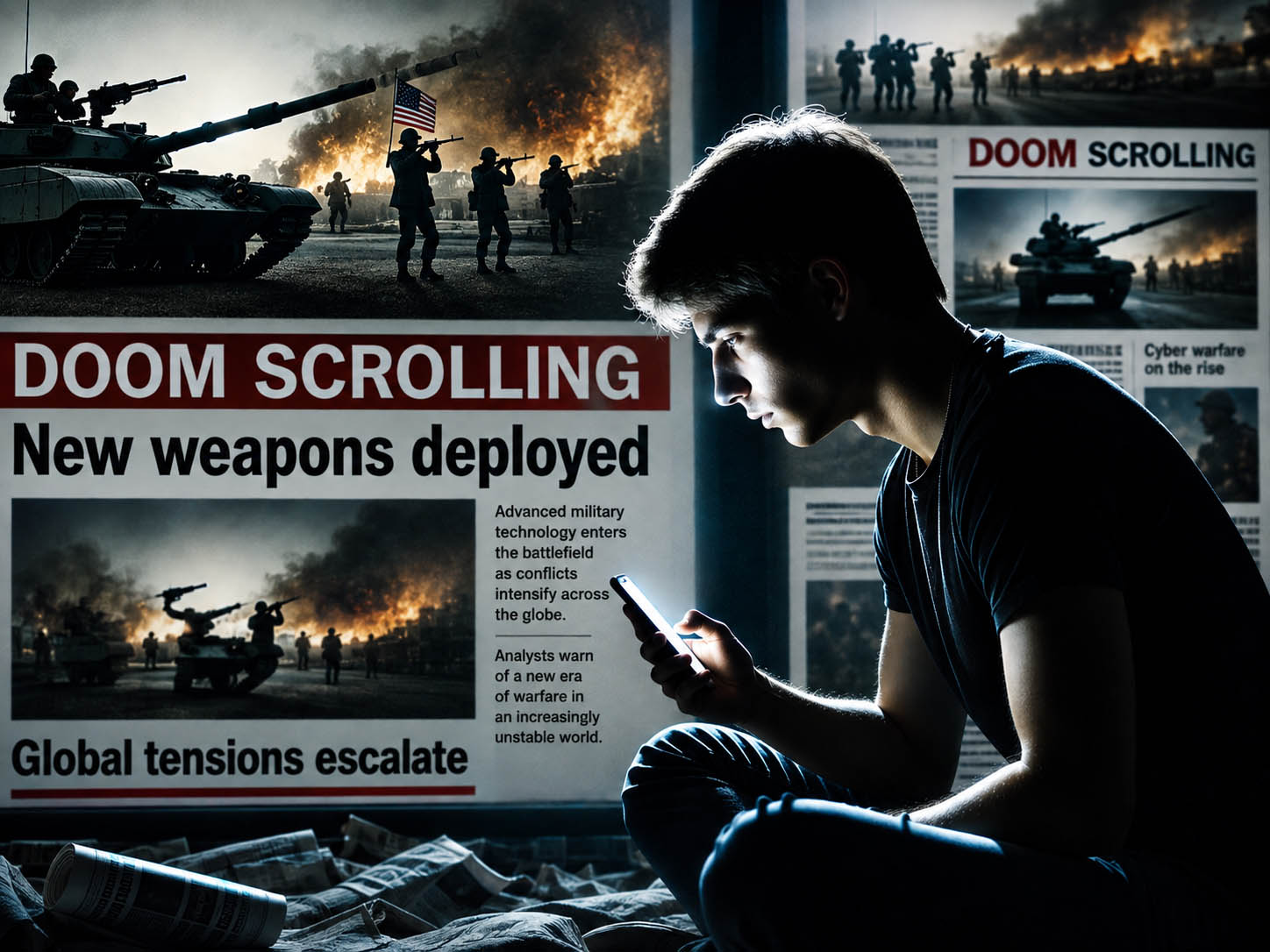
One of the most significant risks of doomscrolling is its impact on mental health. Constant exposure to stories about war, crime, natural disasters, political conflict and economic uncertainty can leave people feeling overwhelmed, anxious and emotionally exhausted.
Research suggests that repeated exposure to threatening information may place people into a state of hypervigilance, where they become increasingly alert to potential dangers around them (Sweeny & Dooley, 2017). While this response can be useful during genuine threats, remaining in this heightened state for long periods can increase stress levels and make it difficult to relax.
Doomscrolling can also reinforce cycles of worry and rumination. Rather than helping people feel informed or prepared, repeatedly consuming distressing news may leave them feeling powerless over events they cannot control. This ongoing focus on negative information has been associated with increased anxiety, lower mood and poorer psychological wellbeing (Boursier, Gioia, Musetti & Schimmenti, 2020).
Over time, some people begin to develop a more pessimistic view of the world, feeling as though negative events are happening constantly. This can contribute to feelings of hopelessness, emotional exhaustion and reduced resilience when coping with everyday stress.
One of the most common consequences of doomscrolling is disrupted sleep. Many people intend to check the news for just a few minutes before bed, only to find themselves still scrolling much later than planned.
Research has shown that using electronic devices before bedtime can delay sleep onset, reduce sleep quality and increase daytime fatigue (Chang, Aeschbach, Duffy & Czeisler, 2015). When this is combined with repeated exposure to emotionally distressing news, the brain may remain alert long after the phone has been put down, making it more difficult to fall asleep.
Poor sleep can have a significant impact on overall wellbeing. It reduces emotional regulation, increases irritability, makes it harder to manage stress and can impair concentration throughout the day. Chronic sleep disruption has also been associated with poorer physical health and an increased risk of a range of long-term health conditions (Walker, 2017).
Problematic doomscrolling can gradually begin to affect everyday life and relationships.
People who become preoccupied with negative news may find themselves checking headlines throughout the day, interrupting conversations or struggling to remain present with family and friends. Instead of enjoying everyday experiences, their attention is repeatedly drawn back to the latest crisis or breaking news story.
Friends and family may also notice increased anxiety, pessimism or emotional withdrawal. Conversations may increasingly revolve around distressing world events, making it more difficult to switch off, relax or enjoy positive experiences together (Satici, Saricali, Satici & Griffiths, 2020).
Over time, this constant focus on negative information can reduce overall life satisfaction and make it harder to maintain healthy relationships and emotional balance.
Doomscrolling can also affect attention, concentration and decision-making.
Constantly switching between news articles, social media posts and breaking updates fragments attention and increases cognitive load. Research suggests that heavy digital media use can reduce working memory and make it more difficult to focus on tasks for extended periods (Rosen et al., 2013).
Many people also describe feeling mentally drained after long periods of doomscrolling. Rather than feeling more informed, they may struggle to concentrate at work or study, complete everyday tasks or make decisions because their attention remains focused on distressing information.
Some individuals also use doomscrolling as a way of avoiding their own worries or responsibilities. Instead of addressing challenges in their own lives, they become caught in an endless cycle of consuming news about global events. While this may provide temporary distraction, it can contribute to procrastination, reduced productivity and difficulty disengaging from digital media (Elhai, Levine, Dvorak & Hall, 2017).
Staying informed about current events is an important part of modern life, but excessive doomscrolling can come at a cost. Constant exposure to distressing news has been associated with increased anxiety, disrupted sleep, emotional exhaustion, reduced concentration and lower overall wellbeing.
Recognising when news consumption has become unhelpful is an important first step. Setting boundaries around when and how often you check the news, taking regular breaks from digital media and balancing negative news with meaningful offline activities can help reduce the psychological impact of doomscrolling while still allowing you to stay informed.
Berolo, S., Wells, R. P. & Amick, B. C. (2011). Musculoskeletal symptoms among mobile handheld device users and their relationship to device use: A preliminary study in a Canadian university population. Applied Ergonomics, 42(2), 371-378.
Boursier, V., Gioia, F., Musetti, A. & Schimmenti, A. (2020). Facing loneliness and anxiety during the COVID-19 isolation: The role of excessive social media use in a sample of Italian adults. Frontiers in Psychiatry, 11, 586222.
Chang, A. M., Aeschbach, D., Duffy, J. F. & Czeisler, C. A. (2015). Evening use of light-emitting eReaders negatively affects sleep, circadian timing and next-morning alertness. Proceedings of the National Academy of Sciences, 112(4), 1232-1237.
Elhai, J. D., Levine, J. C., Dvorak, R. D. & Hall, B. J. (2017). Fear of missing out, need for touch, anxiety and depression are related to problematic smartphone use. Computers in Human Behavior, 63, 509-516.
Rosen, L. D., Lim, A. F., Carrier, L. M. & Cheever, N. A. (2013). The role of media use in adolescent sleep, attention and academic performance. Journal of Adolescence, 36(4), 741-749.
Satici, B., Saricali, M., Satici, S. A. & Griffiths, M. D. (2020). Intolerance of uncertainty and mental wellbeing: Serial mediation by rumination and fear of COVID-19. International Journal of Mental Health and Addiction, 19(6), 2746-2758.
Sweeny, K. & Dooley, M. D. (2017). The surprising upsides of worry. Social and Personality Psychology Compass, 11(4), e12311.
Verduyn, P., Ybarra, O., Résibois, M., Jonides, J. & Kross, E. (2017). Do social network sites enhance or undermine subjective well-being? A critical review.
Walker, M. (2017). Why We Sleep: Unlocking the Power of Sleep and Dreams.
Should you find any content in these articles in any way distressing, please seek support via Find a Help Line
Seek Help